Hamilton Park

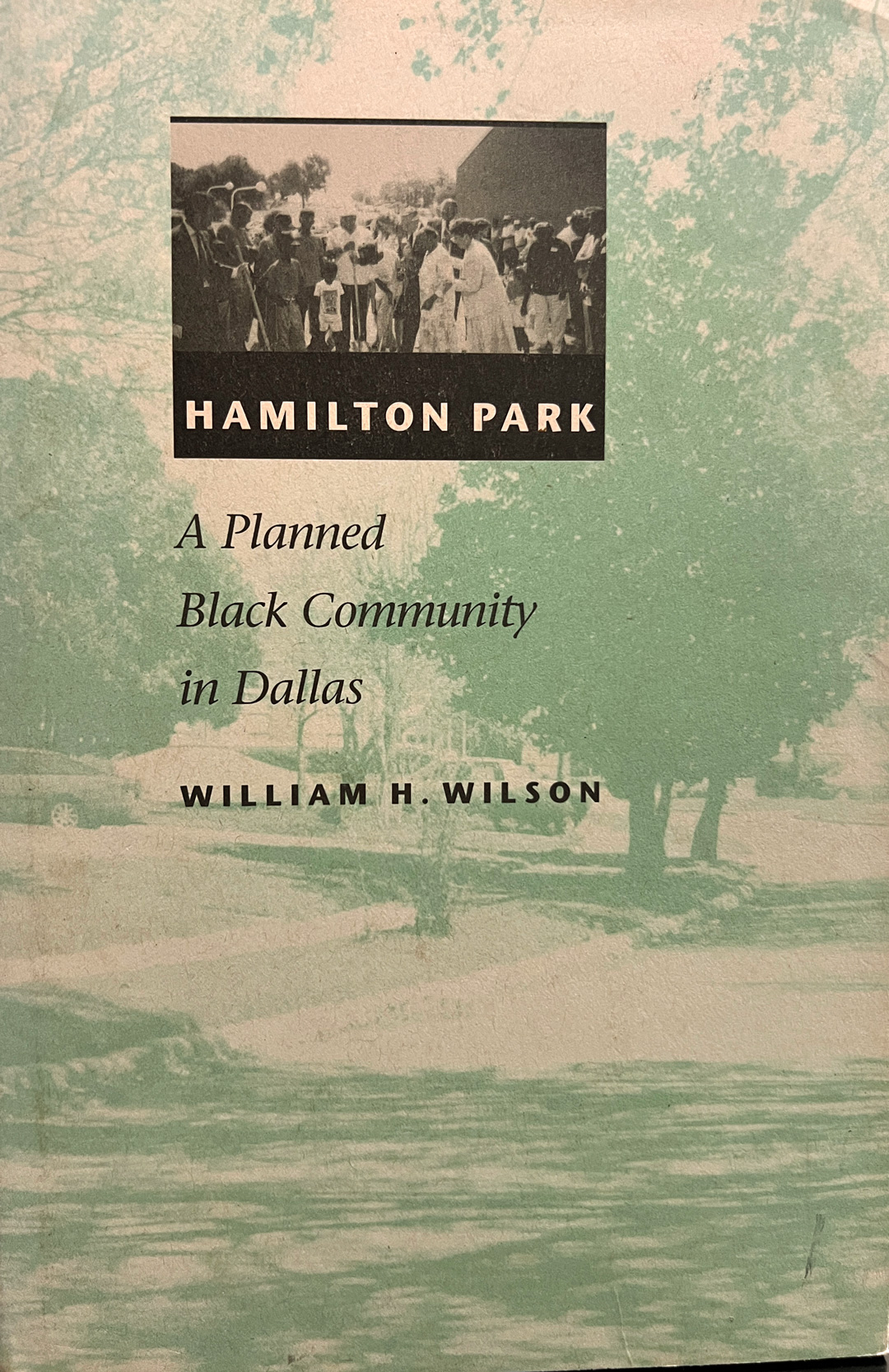
The background of this book cover is a soft, green-tinted picture of a quiet street with tall, leafy trees and pretty lawns. Near the top, there is a small black-and-white photo showing a group of Black people gathered together. Inside a bold black box, the title "HAMILTON PARK" stands out in white letters. Right below is the subtitle: "A Planned Black Community in Dallas." At the bottom, the author’s name, "WILLIAM H. WILSON," is printed.

William H. Wilson, 1998

World War II brought staggering changes to Dallas, Texas, as the city became a banking, commercial, and transportation center. The growing population strained available housing and put particular pressure on already overcrowded African-American neighborhoods. In Hamilton Park,William Wilson brings to light the stirring history of how both black and white citizens of Dallas worked together to create a thriving African-American planned community. Through interviews with pioneer residents and development planners coupled with research into the politics and problems they faced, Wilson traces the evolution of Hamilton Park from idealistic plans to true residential community.

Placing this movement by Dallas blacks to obtain decent housing into the broader context of rapid postwar growth in the United States, Wilson examines how the assault on housing segregation waged by Dallas’s black leadership matched the struggles of African-American leaders throughout the nation. He outlines the dilemma of identifying and procuring a suitable tract of land―one large enough, near African-American employment, and far enough from whites’ neighborhoods that the development would not be opposed. He also examines individual struggles, from procuring utilities in the new neighborhood to arranging financing for new home buyers to choosing street names.

Beyond these practical issues faced by early planners and pioneer residents, Wilson meticulously describes and evaluates the evolution of the community of Hamilton Park. He looks at the roles that neighborhood covenants―and residents’ challenges to them―as well as civic organizations, garden clubs, public schools, and churches played in defining and redefining a dominant culture in Hamilton Park. His short biographical sketches of residents and of white elites add a compelling personal narrative to traditional landscape history and the history of planning. Hamilton Park will interest scholars of Texas history, urban studies, environmental studies, American studies, African-American studies, and sociology.

Published in cooperation with the Center for American Places, Harrisonburg, Virginia

William Wilson earned a Bachelor in Journalism in Journalism in 1957 from the University of Missouri. He earned a Master of Arts in History in 1958 and a Doctor of Philosophy in History in 1962 from the same university. He taught at the University of South Dakota in 1962 and the University of Alaska, Fairbanks from 1963 to 1967. He then joined the University of North Texas in 1968. He would remain at UNT until his retirement in 2001. He held the positions of associate professor, professor of history and regent’s professor of history. Upon his retirement he was named professor emeritus. Dr. Wilson was honored with the Lewis Mumford Price from the Society for American City and Regional Planning History in 1989. He also won the Outstanding Book of the Year in architecture and urban planning from the Association of American Publishers in 1989.

DETAILS

Title: Hamilton Park: A Planned Black Community in Dallas

Author: William H. Wilson

Publisher: The Johns Hopkins University Press

Publication Date: 1998

Page Count: 256

Notes: Hardcover. First Edition.