
white metropolis: race, ethnicity, and religion in dallas, 1841-2001
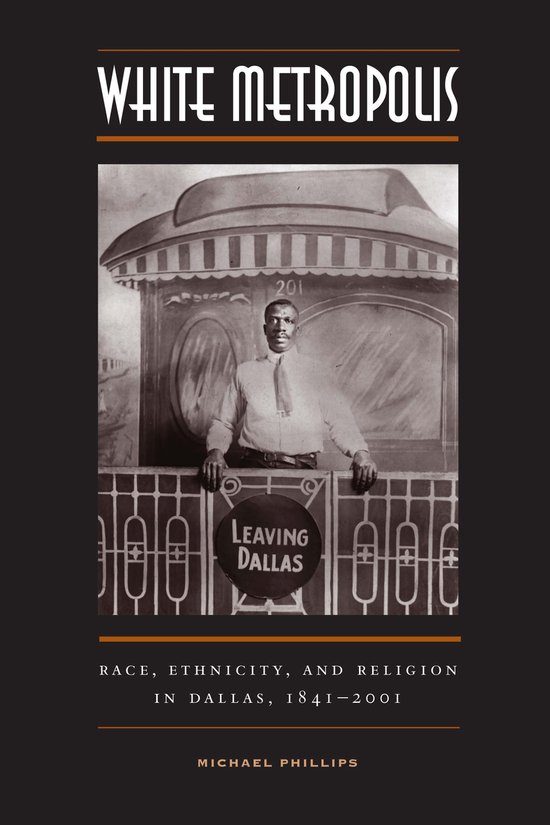
Michael Phillips, 2006
From the nineteenth century until today, the power brokers of Dallas have always portrayed their city as a progressive, pro-business, racially harmonious community that has avoided the racial, ethnic, and class strife that roiled other Southern cities. But does this image of Dallas match the historical reality? In this book, Michael Phillips delves deeply into Dallas’s racial and religious past and uncovers a complicated history of resistance, collaboration, and assimilation between the city’s African American, Mexican American, and Jewish communities and its white power elite.
Exploring more than 150 years of Dallas history, Phillips reveals how white business leaders created both a white racial identity and a Southwestern regional identity that excluded African Americans from power and required Mexican Americans and Jews to adopt Anglo-Saxon norms to achieve what limited positions of power they held. He also demonstrates how the concept of whiteness kept these groups from allying with each other, and with working- and middle-class whites, to build a greater power base and end elite control of the city. Comparing the Dallas racial experience with that of Houston and Atlanta, Phillips identifies how Dallas fits into regional patterns of race relations and illuminates the unique forces that have kept its racial history hidden until the publication of this book.
Michael Phillips is a scholar of American race relations, Texas history, right-wing politics, and apocalyptic religions.
Phillips grew up in Garland, Texas, just north of Dallas. He received a journalism degree from the University of Texas at Arlington in 1983 and worked at various newspapers in North Texas from 1983-1990, including the Fort Worth Star-Telegram. At the Star-Telegram, he covered the nighttime Fort Worth police beat, an experience which inspired his interest in how American media amplify racism and the history of white supremacist ideology in North Central Texas. After earning his master’s degree in history from the University of California at Riverside in 1994, he received his Ph.D. from the University of Texas at Austin in 2002. His dissertation won the University of Texas at Austin Outstanding Dissertation Award and was published as White Metropolis: Race, Ethnicity and Religion in Dallas, 1841 2001. White Metropolis was awarded the 2007 Texas Historical Commission’s T. R. Fehrenbach Award for best book on Texas history.
In 2010, he co-authored The House Will Come to Order: How the Texas Speaker Became a Power in State and National Politics with Dr. Patrick Cox. He also contributed chapters to Beyond Texas Through Time: Breaking Away from Past Interpretations (2011); The Harlem Renaissance in the West: The New Negroes’ Western Experience (2011); and The Texas Right: The Radical Roots of Lone Star Conservatism (2014); Steeped in a Culture of Violence: Murder, Racial Injustice, and Other Violent Crimes in Texas, 1965–2020 (College Station: Texas A&M University Press, 2023) and All-American Massacre: The Tragic Role of American Culture and Society in Mass Shooting.
Topics included in Phillips’s writings include Black art in North Texas during the 1920s and 1930s, how Texas historians have analyzed race and gender since the 1980s, how racism and immigration shaped Texas’s political culture from the 1880s to the World War I era, police violence against African Americans and the Latinx community, and the evolution of the white supremacist “Great Replacement Theory” discourse from the time of Puritan colonization of New England in the 17 th century.
In addition to the Fehrenbach Award, Phillips has received many honors. He received the Baylor University Charlton Oral History Research Grant in 2013 and spent the next year recording the experiences of faculty and alumni of the state’s Historically Black Colleges and Universities (HBCUs) from the 1940s until the early twenty-first century. With his research and writing partner Betsy Friauf, he won the East Texas Historical Association’s C.K. Chamberlain Award for Best Article of the Year in 2018 and the Texas Oral History Association’s Kenneth E. Hendrickson, Jr. Sound Historian Best Article in 2021.
In 2019 he was among the first cohort of community college professors to receive a Mellon/American Council of Learned Societies Community College research fellowship for his project on the history of eugenics in the state of Texas. Phillips and Friauf are under contract with the University of Oklahoma Press to write an upcoming book, The Strange Career of Eugenics in Texas, 1854-1940.
Strange Career will examine the history of the eugenics movement in Texas, the political, cultural, and economic reasons why Texas was one of only 16 states that did not pass a sterilization law during the heyday of the movement, and how the historic concerns and obsession with eugenicism nevertheless shape Texas society today.
While teaching American history at Collin College in Plano, Texas, from 2007-2022, Phillips served as faculty co-sponsor of three student organizations: the Collin College chapter of Students Demand Action, the Muslim Students Association, and Working-Class Heroes, and served on the steering committee of the Texas Center for Working Class Studies.
One of his students wrote of Phillips, “I hated history until I had him as a teacher. He never sugarcoats anything. He told it how it was. I appreciated that a lot. He’s a great professor.” In another evaluation a student said, “He is passionate and makes his in-person lectures more than engaging. I loved being in his class because there is such a wonderful learning environment. Not only does he tell us the historical information, but he also helps us engage in thinking by connecting the dots between different historical events.”
He’s made more than sixty presentations on Dallas history and the idea of race to colleges and universities, civic organizations, churches, synagogues, and mosques in the Dallas-Fort Worth metropolitan area since 2006. Phillips was a leader in the campaign to remove Confederate monuments in the Dallas area. He also launched the successful effort to change the name of the administration building at his alma mater, the University of Texas at Arlington, which honored a eugenicist, Edward Everett Davis. The East Texas Historical Association awarded Phillips the Ottis Lock Award for Educator of the Year in 2021.
The Clements Center for Southwest Studies at Southern Methodist University named him a senior research fellow for the 2022-2023 term. Phillips is now an independent scholar.
DETAILS
Title: White Metropolis: Race, Ethnicity, and Religion in Dallas, 1841-2001
Author: Michael Phillips
Publisher: University of Texas Press
Publication Date: 2006
Page Count: 299
Notes: Paperback. First Edition.

